
Composition and storytelling
Composition and visual storytelling
Rule of thirds, leading lines, depth, scale, negative space and shot sizes.
Composition is how you arrange the frame so the viewer knows what matters. These concepts apply to a virtual flight exactly as they do to a real camera.
Rule of thirds
Imagine the frame divided into a 3×3 grid. Placing a subject on one of the lines or intersections often feels more dynamic than centring it. In FPV Map, Settings → HUD guides draws the grid for you.
The rule is a starting point, not a law. A centred subject can be stronger when symmetry is the point.
Leading lines
Roads, coastlines, bridges and rows of buildings pull the eye through the frame. Use them to point at the subject, not away from it. In the Financial District, a street canyon can lead directly to the pyramid.
Foreground, middle ground and background
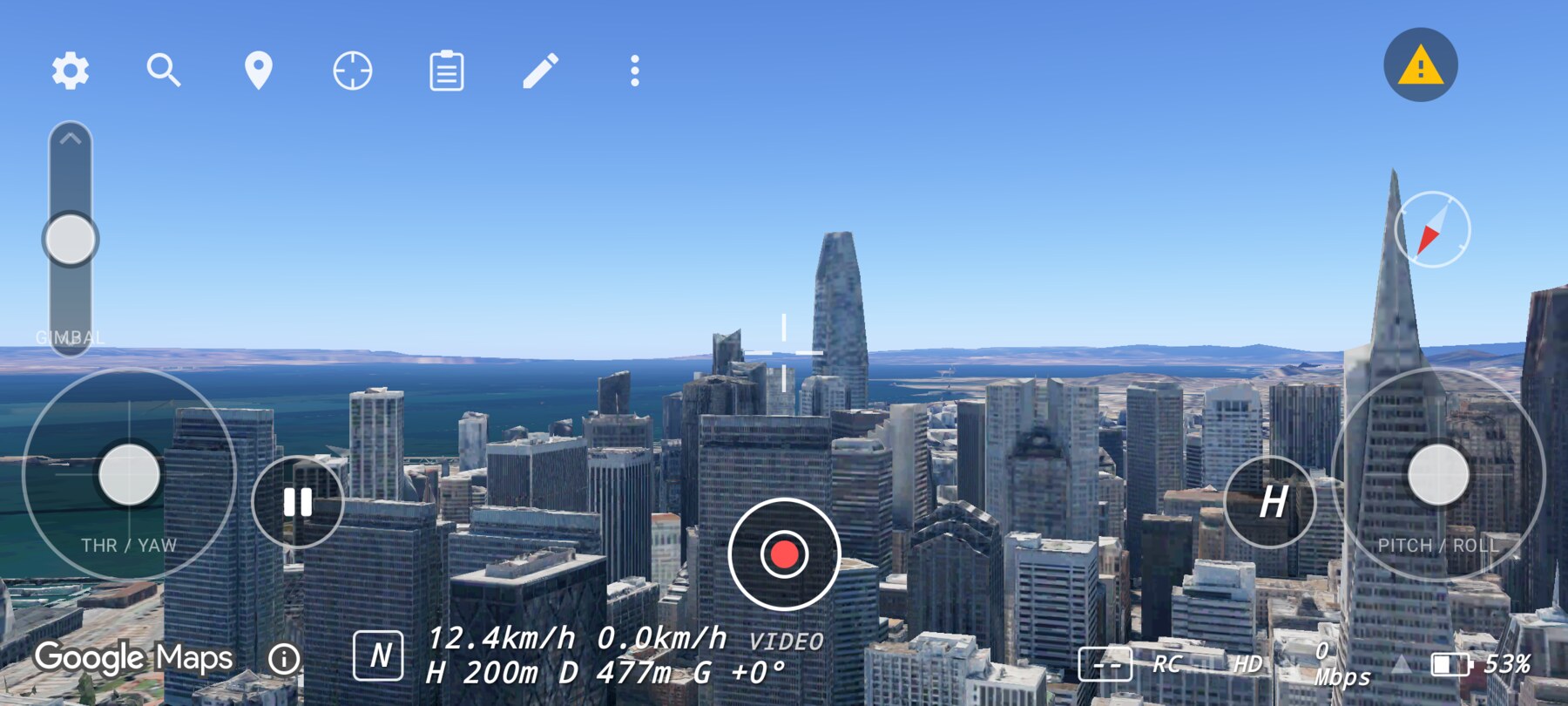
Depth comes from layers. A rooftop in the foreground, a tower in the middle ground and the bay in the background give the eye three distances to explore. Even two layers are enough to make a frame feel three-dimensional.
Scale and visual context
A building with no reference looks like a shape. A building beside a street, a bridge or a known tower looks like a place. Include something the viewer can measure against.
Negative space
Empty sky or water is not wasted space; it gives the subject room to breathe. A frame packed with detail can feel claustrophobic. Try leaving one third of the frame deliberately quiet.
Symmetry and central composition
Centring a subject works when the frame is balanced: a tower in the middle, a road vanishing to the same point, or a reflection that mirrors the skyline. Symmetry is strongest when it is precise; a near-symmetric frame often looks accidental.
Horizon placement
Put the horizon high to emphasise the ground, or low to emphasise the sky. A horizon through the exact middle often looks unresolved. For a skyline, a low horizon gives the towers more presence.
Framing with the environment
Roads, coastlines, bridges, buildings and terrain can act as a frame inside the frame. A gap between two towers can isolate the pyramid; a bridge cable can add a diagonal; a hill can hide and reveal.
Movement direction and attention
The eye follows motion. Moving toward the subject increases attention; moving away gives context. Moving sideways reveals relationships. Choose the direction that matches the sentence the shot supports.
Shot size and sequence
- Wide: where are we?
- Medium: what is the subject doing?
- Detail: what makes it specific?
- Transition: how do we leave?
A sequence that moves wide → medium → detail feels deliberate. Three wide shots in a row feel flat.
Match the movement to the story
A calm voiceover suits a slow pull-away; a fast music cut suits a tracking pass. The camera move is part of the rhythm, not an independent decoration.
A simple checklist before recording
- Is the subject obvious in one word?
- Is the horizon where I want it?
- Is there a foreground layer?
- Does the movement add information?
- Are the first and last frames usable?
- Is there enough quiet space in the frame?
- Would a static frame say it better?
Learn the concept
- Composition (visual arts) — Wikipedia
- Rule of thirds — Adobe
- Parallax — Wikipedia
Related guides
About the screenshots
Every screenshot and demo in this documentation was captured in FPV Map over the Transamerica Pyramid and the Financial District, San Francisco.
FPV Map is a simulator. It never sends commands to an aircraft, and virtual rehearsal is not a substitute for legal checks, a site survey or safe piloting.
Found a mistake or something that no longer matches the app? Report it.